logo
RESCUE

Announcements


​

08 September 2026

[Seminar] Bed Bugs in Hospitality: What Every Hotel Worker Should Know

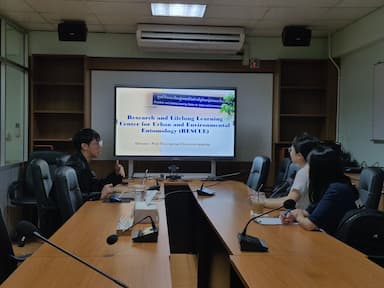
🌟 Seminar Announcement Bed Bugs in Hospitality: What Every Hotel Worker Should Know The Research and Lifelong Learning Center for Urban and Environmental Entomology (REAL‑ENTO), Kasetsart University, is pleased to invite students from the Department of Hospitality and Tourism Industry to a special seminar bridging entomology and tourism management. 📅 Date & Time: Tuesday, September 8, 2026 | 1:00 PM – 3:00 PM 📍 Venue: REAL‑ENTO Meeting Room, Kasetsart University 🔎 Seminar Highlights Top 10 myths about bed bugs Biology and health risks Real case studies from hotels and dormitories Impact on tourism reputation and customer satisfaction This seminar offers practical knowledge for future hospitality professionals , helping students understand how urban pests affect guest experience, hotel operations, and brand reputation. Registration: Please register via the QR code on the poster or through the following link: https://docs.google.com/forms/d/e/1FAIpQLSeZ04Z_EpBIRDLGOu_OLPFV6gMB00Is6mVJez7nBm2LB-EeoA/viewform?usp=sharing&ouid=102443055205205977468 We warmly welcome both Thai and international program students to join this unique learning opportunity. Organizer: Dr. Daeyun Kim REAL‑ENTO, Kasetsart University
training
bed bug
Hospitality
Tourism

03 September 2026

[Training] Termites in Urban Communities by Ajarn Amonrat (29 Aug. 2026)

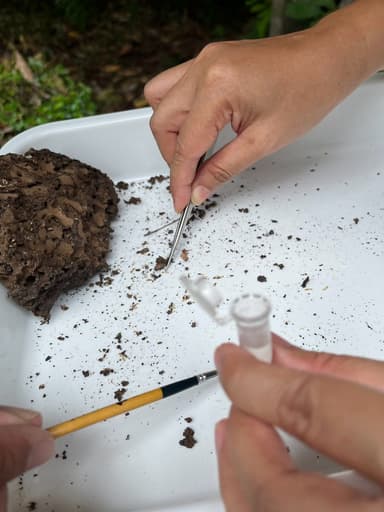
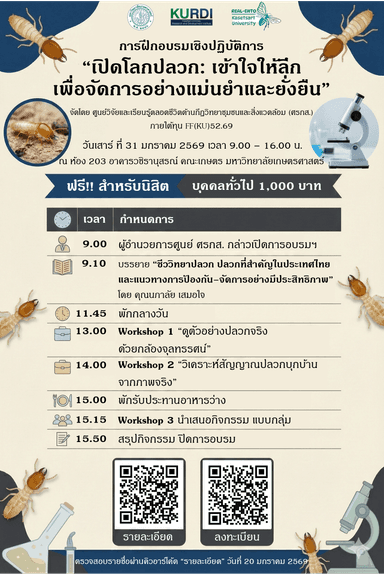
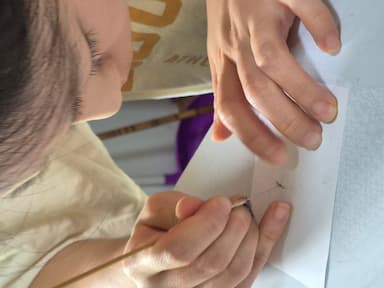
Workshop II: Termites in Urban Communities – From Fieldwork to Species Identification successfully concluded on August 29, 2026, at Kasetsart University. Participants gained hands‑on experience in field collection, specimen preparation, and species identification , guided by Dr. Amonrat Panthawong. Thank you to all 20 participants for your enthusiasm and commitment to advancing urban ecology knowledge. Kasetsart University invites you to Workshop II: Termites in Urban Communities – From Fieldwork to Species Identification on Saturday, August 29, 2026 (09:00–16:00) at the Faculty of Science. Led by Dr. Amonrat Panthawong , the training covers field collection, specimen preparation, and species identification of termites in Thailand. Free for KU students / 950 Baht for public Registration closes August 15, 2026 Seats limited to 20 For details and registration, contact 083-025-9951 or amornrat.pan@ku.th . “From soil to microscope 🔍✨ Termite Workshop II was a success!” “Hands‑on science, real community impact 🌱🪲” “20 participants, countless discoveries, one shared mission 💡” “Kasetsart University’s Termite Workshop II: advancing urban ecology through fieldwork and species identification.” “Learning together, identifying termites, building solutions for communities.” “Thank you to Dr. Amonrat and all participants for making this workshop impactful.” “Science meets community 🏙️🪲 Termite Workshop II brought knowledge to action.” “Field surveys ➡️ Lab prep ➡️ Species ID ➡️ Shared learning 💬” “Together, we’re tackling termite challenges in urban environments.” We wrapped up Workshop II: Termites in Urban Communities with great energy and collaboration. From collecting samples in the field to identifying species in the lab, participants learned practical skills to help manage termite challenges in urban settings. Special thanks to our trainer, Dr. Amonrat and to everyone who joined us. Your participation strengthens the bridge between science and community action!

20 April 2026

[MOU] Dibrugarh University and Real-Ento (6 March 2026)

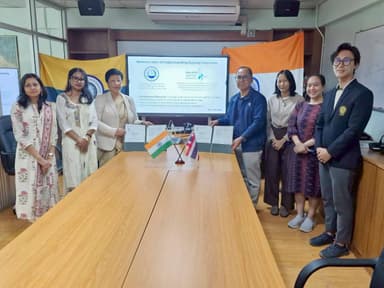
Real-Ento recently hosted an intensive one-week international training program titled, "Mosquito Laboratory Culturing, Bioassays, Trapping, and Identification" from 3-11 March 2026. The program welcomed trainees from Dibrugarh University, marking important step toward strengthening global collaboration in vector research and control. Throughout the course, participants gained comprehensive, hands-on experience in mosquito laboratory techniques. This included colony establishment and maintenance, as well as specialized skills such as force mating. Trainees were also introduced to both morphological and molecular approaches for accurate mosquito identification which are essential tools for modern vector surveillance and research. Building on these foundations, the program explored a range of field and laboratory methodologies. Participants learned to deploy host-seeking and oviposition traps to collect mosquitoes for further investigation. These collections were then used to assess insecticide resistance using standardized bioassays, including the widely adopted WHO bottle bioassay. The training also emphasized behavioral studies under sub-lethal exposure conditions. Using advanced systems such as the Excito-Repellency Assay (ERA) and High-Throughput Screening System (HITSS), participants evaluated mosquito responses to repellents providing critical insights for vector control strategies. Additionally, recent experience using AI powered mosquito trapping methods in the field briefly introduced for further collaboration potential. These integrated training components are expected to directly support ongoing research and surveillance efforts in the participants' home region, contributing to more effective vector mosquito management. Beyond technical capacity building, this program represents a milestone in international academic partnership. A Memorandum of Understanding (MoU) has been established between Dibrugarh University and Real-Ento, with support from the PM-USHA (Pradhan Mantri Uchchatar Shiksha Abhiyan) initiative under the Department of Higher Education, Government of India. This agreement lays the foundation for sustained collaboration in research, training, and knowledge exchange between India and Thailand. Years in the making, this initiative reflects Real-Ento's commitment to fostering long-term, transnational partnerships. More than a single training event, it stands as a model for building enduring research networks that address shared challenges in vector-borne disease management.

16 March 2025

[Training] (February 19–20, 2025) Training Course on Mosquito Rearing and Identification (2/2)

[Training] (February 19–20, 2025) Training Course on Mosquito Rearing and Identification (2/2) Day 2: Mastering Force Mating Techniques The second day of training focused on force mating , a crucial technique for increasing mosquito populations in laboratory settings. Mr. Max, a seasoned expert in Anopheles dirus force mating, demonstrated his precise handling of male and female mosquitoes. His years of experience were evident as he guided the trainees through each step with skillful precision. Following the demonstration, Dr. Lee and Prof. Kim had the opportunity to practice under Mr. Max’s in-person supervision. Impressively, Dr. Lee displayed exceptional stability and accuracy in handling mosquitoes , thanks to her extensive Ph.D. research experience. Prof. Kim , a seasoned medical entomologist with years of fieldwork, quickly grasped the technique and adapted to the process with ease. During the morning session , both trainees practiced on approximately 100 female mosquitoes , using a higher number of males to improve success rates. Their enthusiasm was evident as they continued practicing even after lunch , determined to refine their skills. By the end of the session, they had successfully force-mated hundreds of females and monitored fecundity rates after blood feeding using an artificial feeding system with expired human blood . Applying New Skills and Concluding the Course After an intensive day of training, Prof. Kim and Dr. Lee successfully acquired force mating skills that they can now implement in their own laboratory at Seoul National University . With summer field collections starting in early June , they will soon apply these techniques to boost mosquito populations in their lab. To wrap up the two-day course, participants conducted species identification of key Thai vector mosquitoes, including: ✅ Aedes aegypti ✅ Anopheles minimus ✅ Anopheles dirus ✅ Culex quinquefasciatus The session concluded with an open discussion , where trainers and trainees shared their reflections on the course. The atmosphere was filled with passion, dedication, and a shared commitment to advancing medical entomology . It was a touching moment—everyone could feel the energy and enthusiasm of the next generation of medical entomologists , who will likely become long-term research collaborators. We sincerely thank the trainees for their hard work and enthusiasm in mosquito research, contributing to the protection of public health in both Korea and Thailand . Hope to see you all again in the near future! Take care, and all the best!

16 March 2025

[Training] (February 19–20, 2025) Training Course on Mosquito Rearing and Identification (1/2)

(February 19–20, 2025) Training Course on Mosquito Rearing and Identification (1/2) The Research and Lifelong Learning for Urban and Environmental Entomology (RESCUE) program successfully conducted its first training course of the year on mosquito rearing and identification . Trainees from Seoul National University , including Assist. Prof. Kim and Dr. Lee , gained hands-on experience in force mating—an essential skill for increasing the population of field-collected mosquitoes in laboratory settings. Day 1: Orientation and Mosquito Insectarium Tour Mr. Max opened the session with an overview of RESCUE and the mosquito insectarium , explaining the objectives and structure of the two-day training course. The program was designed to address the specific needs of the trainees, with a particular focus on force mating techniques. Following the orientation, Mr. John guided the trainees through the step-by-step process of mosquito lab culturing. His in-person guidance provided valuable insights into the practical aspects of maintaining a successful mosquito colony. During the session, Mr. John emphasized that one of the key factors in achieving a high yield of newly emerged adult mosquitoes lies in precise larval feeding . He highlighted the importance of water quality, particularly for Anopheles spp. , and demonstrated how to provide the optimal amount of larval food. Hands-On Practice: Preparing Mosquito Larval Food Trainees had the opportunity to prepare finely powdered mosquito larval food using a traditional Thai grinding tool instead of electric devices. This method, passed down through generations, offers a simple yet effective alternative for mosquito rearing. Sometimes, basic yet practical knowledge can be the key to solving complex challenges in laboratory mosquito culturing. Recognizing this, the trainees eagerly took notes, recorded each step, and engaged in in-depth discussions. The Value of In-Person Training The highlight of the training was the direct interaction with local Thai researchers . By engaging in open discussions, participants and trainers were able to exchange experiences, ask relevant questions, and explore solutions to real-world challenges. These meaningful conversations not only enhanced technical skills but also paved the way for potential research collaborations. Day 1 concluded with a full-day insectarium visit and intensive knowledge-sharing session , setting a strong foundation for the following day's activities. (To be continued...)
logo

RESCUE

The Research and Lifelong Learning Center

on Urban and Environmental Entomology

Department of Entomology

Faculty of Agriculture-Bangkok

Kasetsart University, Bangkok, Thailand 10900

Contact

Facebook

Youtube

© Copyright 2026 • RESCUE • All Right Reserved